
November 25, 2025 | By Nick Pfost
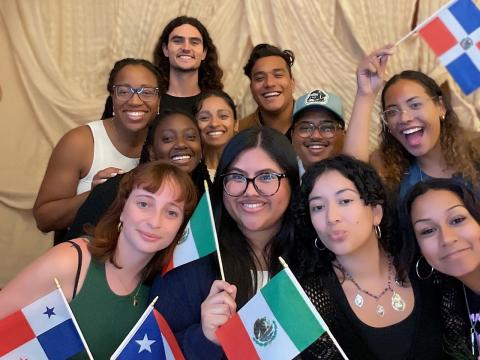
Laughter rang out across the room as people gathered earlier this fall for the Latine Heritage Month Opening Ceremony, welcomed by familiar faces and new friends. Tables were set for a shared meal, while art and conversation filled every corner. At the heart of it all, connections were forming.
Student organizer Ahtziri Pasillas-Riquelme reflected, “It’s amazing to see how many people come together, especially when I sometimes feel separated from it all.”
These are the moments that define Latine Heritage Month at the University of Michigan, led by the Office of Multi-Ethnic Student Affairs (MESA).
Building a welcoming community
From mid-September through mid-October, Latine Heritage Month brought together hundreds of students and dozens of campus partners across 20 separate gatherings. MESA’s planning committee of students and staff organized the month, working with fellow Student Life units like the Trotter Multicultural Center, as well as academic departments like LSA Latina/o Studies and Rackham Graduate School; and student organizations like La Casa, Caribbean Student Association, and Phi Iota Alpha Fraternity, Inc. U-M students, faculty, and staff, regardless of racial or ethnic background, were invited to join events that highlight the diversity and depth of Latine/a/o/x cultures, communities, and histories.
For students who feel far from home, these gatherings offer a warm welcome. Isabella Cortes, a Stamps School of Art & Design student, shared that joining Latine Heritage Month activities was a source of comfort during her transition to college life. “With being away from home, I’ve felt disconnected from my culture and identity that used to surround my everyday life... Events like these bring comfort and help remind me that I'm not alone here at college.”
This year’s theme, El Orgullo de Ser / The Pride of Being / O Orgulho de Ser, was chosen by the committee to celebrate pride in individual and collective achievements, the accomplishments of loved ones, and the shared strength of community.
Pasillas-Riquelme recalled how the opening ceremony brought people together, “I got to meet new people, but I also saw familiar faces—people who still care about events like this.”
Creating space for authentic relationships
Throughout the month, U-M’s campus is alive with opportunities—from collaborative workshops and guest speakers to art showcases and cultural meals, all centering Latine stories, and open for participation regardless of one’s background.
The “Canvas of Identity” art show invited students to share work reflecting their journeys. Cortes contributed a piece “focused around navigating my identity as a Chicana and items and stories I noticed brought me comfort as I began my journey into adulthood.”
The events are meaningful not just for their content, but for how they foster connection and reflection.
Emmanuel Saldana, a Latine Heritage Month committee member, described the impact of the opening ceremony, featuring acclaimed author Erika L. Sánchez: “She definitely evoked something within me, making me feel more motivated and concentrated to continue to work hard as a student and develop a path for my community, especially since I’m a first-gen student.”
Collaborative events, like the Latine-Caribbean dance workshop organized with the Caribbean Student Association, were intentionally designed to honor the overlap and uniqueness within Latine and Caribbean communities. Kristin Ferreras Lora from CSA remarked, “I hope our work encourages the campus community to gain a deeper understanding of the vast diversity within Latinidad.”
“Celebrating these differences not only strengthens cultural appreciation but also builds solidarity across communities.”
From new friendships to campus collaboration
Latine Heritage Month is as much about education and building social capital as it is about celebration. In our 2024-25 annual report, 92% of attendees across all MESA programs said the event they attended made them feel a sense of community, and 91% felt it enhanced their civic and campus engagement.
Saldana reflected, “Working with the committee has definitely broadened my perspective on community building, creativity having no limits, and flexibility when working with others.”
These collective efforts depend on collaboration and mutual respect among units such as MESA, Trotter Multicultural Center, and academic partners, as well as student organizations and staff. Events like the Hispanic Business Student Association conference at Ross, support from OAMI and the Spectrum Center, and outreach to campus sponsors all make meaningful participation possible.
Learning and sharing knowledge
Learning is woven throughout Latine Heritage Month’s programming, from the keynote by Erika L. Sánchez to workshops illuminating intersecting identities.
Sánchez’s keynote at the opening ceremony set a meaningful tone for the month, blending lessons in resilience with the importance of continuing to pursue one’s passions—no matter the obstacles. The Michigan Daily quoted her encouraging attendees: “You’re going to fail so many times, and sometimes you’re going to fail spectacularly, but you have to keep going because you never know what’s on the other side of your failure.”
Her candid reflections underscored the powerful learning outcomes at the heart of Latine Heritage Month programming, inspiring participants not only academically but personally as well.
Participants consistently report personal and academic growth, shaped by these opportunities to reflect and connect. According to data from across all 2024-25 MESA programs the prior year, 85% of event attendees said they gained information that could be applied to their studies.
For Latine Heritage Month itself, students like Isabella Cortes hope their contributions spark meaningful self-reflection: “I want people to have a space where they can step back and think about what they find comforting and prominent within who they are as a person... maybe even question, ‘If I were to make an art piece like this, what would I want to say?’”
Inspiring growth across campus
As we look back at Latine Heritage Month, there’s a noticeable sense of continuity—new relationships and new ideas extend far beyond these few weeks.
Saldana feels his involvement served his own journey and honored those who made it possible for him: “Participating in LHM is definitely special... To represent my parents and community, to show that they overcame barriers, proving anything is possible.”
For Pasillas-Riquelme, the event cycle is a touchstone: “It means so much to me to see people come together to bring Latine Heritage Month to life. It’s one of the best times of the year for me, and I can’t wait to do it one more time before I graduate.”
Coming together, moving forward
As the artwork came down and the last dance was shared, what remains are the connections formed and the sense of pride that carries forward. At Michigan, Latine Heritage Month is about building community, embracing every story, and ensuring that transformative education and belonging ripple across campus all year long.
The pride of being, El Orgullo de Ser, is here to stay.
***
Organizations and units sponsoring Latine Heritage Month events included Ballet Folklorico De Metztli, Caribbean Student Association, Corazones Unidos Siempre Chi Upsilon Sigma National Latin Sorority Inc., Culture Source, Department of American Culture, Department of Astronomy, Department of English, Department of Women’s and Gender Studies, Detroit Observatory, Friends of Guatemala, Hispanic Business Students Association, Independent, Institute for Research on Women and Gender, La Casa, Lambda Theta Alpha Latin Sorority, Incorporated, Latina/o Studies, Leland, MESA's Latine Heritage Month committee, Michigan Housing Community Connections and Engagement, Office of Academic Multicultural Initiatives, Phi Iota Alpha Fraternity, Inc., Residential College, RISE, Ross School of Business, School of Music, Theatre & Dance, SHPE, SHPEtinas, Sigma Lambda Beta International Fraternity, Inc., SOL, Spectrum Center, Theatre Nova, Trotter Multicultural Center, and UAAO.
Read more